My pencil stands still. The left page of my notebook is full of problems. Sequence A is dull. Sequence B feels empty. Sequence C is not motivating. The right page of my notebook is empty. Writer's Block.
There are many facets to making a game, but there is one that unites them all: a game should be fun. Many game developers and game studio websites talk about delight. "We delight our players." This IS the end goal, but it is hardly instructive. How does one inspire delight? When confronted with writer's block what tools can I reach for? What is my theory of creating fun?
As I think about this, I naturally turn the games I enjoy. My Steam library runs a wide gamut. I enjoy single player games, multiplayer games, competitive games, collaborative games, spooky games, silly games...it's tough to identify a common thread through genres or subject matter.
My favorite game of all is Outer Wilds. This game presents you with an enormous space to explore and questions. I love how the action is pushed forward by my curiosity. To me, it is curiosity that is the start of this common thread. Games are an interactive medium, so that curiosity leads to players expressing agency. This leads to anticipation to see the results of the action, and ultimately a set of consequences. Consequences can then lead to other curiosities or inspire a different expression of agency. This is my model of a game loop and how a player can jump from one game loop to another
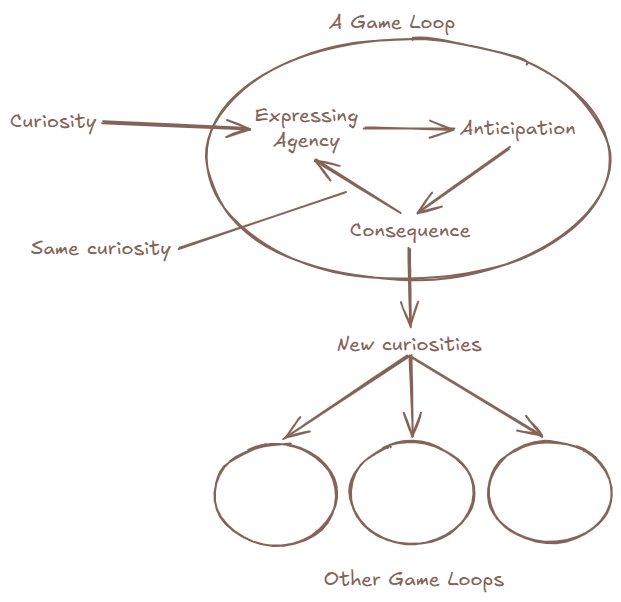
Diagram: Curiosity as motivation for game loops
This is a core framework that I use when thinking about games. The goal with this is to identify which components are missing from an experience. In that same thread it is useful to think about what games are as a medium.
Skill, Spectacle, and Story
Games are an interactive medium. Games are composed of systems that a player interacts with. I call this component of a game Skill. Skill is a player expressing agency. This can be twitch movements in an FPS or choosing a character build in a role-playing game. If players are not expressing agency they might as well be watching a movie.
Games are an auditory and visual medium. For a few decades graphics were an important part of any game review. There was a push for more polygons, better shaders, and a more realistic look. I don't perceive this to be the case anymore, but I do still perceive an importance of spectacle. An arresting vista with golden sunlight bathing castle you are venturing to inspires feelings of awe and determination. A musical score with themes for major characters or ideas can rouse a player to attention when a French horn sounds its low note - indicating that the deadly crocodile is approaching. Without spectacles such as these a player may as well be playing a board game.
Why play a particular game? Why should I keep playing a particular game? Story is a strong answer to this question. Story is what we think about when we are NOT playing a game. It's the trailer hook that pulls in players. What IS the fate of this barely space-worthy society in a solar system around a dying star? Can these kids in this cabin escape or defeat that masked killer chasing them? What is driving this A.I. to experiment on this woman, and how will she break out of that deadly maze? Stories stoke our imagination and drive curiosity towards an answer.
Back to the Page
Sequence A is dull.
What skills can the player be curious about? Is there anything for the player to do? Can we bring in a mechanic for them to exercise, or give a twist to an existing mechanic so they have something new to try out?
Sequence B feels empty.
How can we add spectacle? Is this a lead in to a story beat that we can foreshadow with music? Could we put in a visual monument to motivate the area with some environmental storytelling? Does this sequence crave a set piece that would push things forward?
Sequence C is not motivating.
What story can the player be curious about? What themes of the game can we tie in? How does this moment fit into a story thread that we are failing to emphasize?
Thinking about player curiosity; how that feeds into a game loop; and the skill, spectacle, and story of a moment inspires questions that unblock my creativity and move my game development forward.